
The Plant Kingdom (Kingdom Plantae) includes all multicellular, eukaryotic, photosynthetic organisms that have cellulosic cell walls and store starch as reserve food. Plants are broadly classified into: Algae → Bryophytes → Pteridophytes → Gymnosperms → Angiosperms, representing an evolutionary progression from aquatic to fully terrestrial life with increasing complexity.
Reference Books: NCERT Class 11 Biology (kebo103.pdf) | B.R. Vashist – A Textbook of Botany for BSc | Raven, Evert & Eichhorn – Biology of Plants
Algae are chlorophyll-bearing, thalloid, autotrophic organisms. They are largely aquatic (both fresh water and marine), but can also be found in moist terrestrial habitats. The study of algae is called Phycology (or Algology). Algae lack roots, stems, and leaves — they are simply a thallus (undifferentiated body).
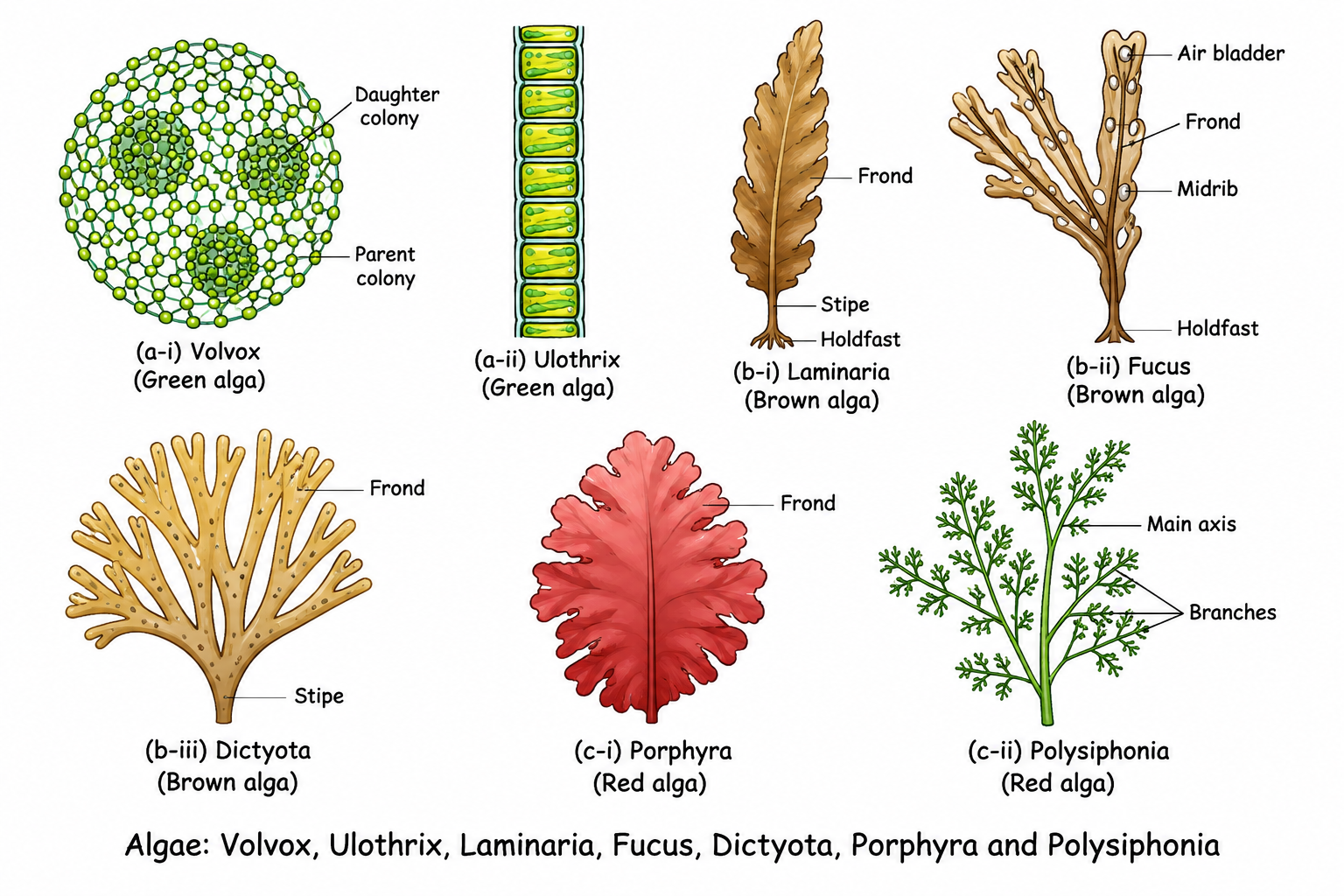
Fig. 3.1 — Diversity of algae: Chlamydomonas, Volvox, Ulothrix, Spirogyra, Sargassum, and Porphyra
Algae are classified primarily on the basis of pigments, reserve food, flagella, and cell wall into three major classes:
| Character | Chlorophyceae (Green Algae) | Phaeophyceae (Brown Algae) | Rhodophyceae (Red Algae) |
|---|---|---|---|
| Common name | Green Algae | Brown Algae | Red Algae |
| Pigments | Chl-a, Chl-b, Carotenoids, Xanthophylls | Chl-a, Chl-c, Fucoxanthin (brown pigment) | Chl-a, Chl-d, r-Phycoerythrin (red), r-Phycocyanin |
| Reserve food | Starch, sucrose, oil | Laminarin, Mannitol | Floridean starch (similar to amylopectin) |
| Cell wall | Cellulose (inner layer), Pectin/Sporopollenin (outer) | Cellulose + Algin | Cellulose + Pectin + Carrageenan/Agar |
| Flagella | 2 or 4 equal, apical (whiplash type) | 2 unequal, lateral; tinsel + whiplash type | Absent (non-motile gametes) |
| Habitat | Freshwater, marine, terrestrial, moist soil | Mostly marine; cooler regions | Mostly marine; deeper waters |
| Examples | Chlamydomonas, Volvox, Ulva, Spirogyra, Ulothrix, Cladophora | Ectocarpus, Dictyota, Laminaria, Sargassum, Fucus | Polysiphonia, Porphyra, Gracilaria, Gelidium |
| Dominant phase | Haploid gametophyte | Diploid sporophyte | Varies (complex life cycles) |
| Sexual reproduction | Isogamy, Anisogamy, Oogamy (all three found) | Isogamy, Anisogamy, Oogamy | Non-motile gametes (oogamy) |
| Economic importance | Food (Chlorella), O₂ producer, biofuel | Algin (industrial), food (kelp), fertilizer | Agar-agar (Gelidium, Gracilaria), carrageenan |
"Green Algae are GREEN because they have both Chl-a and Chl-b (same as land plants)."
"Brown Algae are BROWN because of FUCOXANTHIN — it masks the green colour."
"Red Algae are RED because of r-PHYCOERYTHRIN — they live in deeper water where red light still penetrates."
Remember: Rhodophyceae → Red → r-Phycoerythrin. Red algae can harvest blue/green light that penetrates deep water.
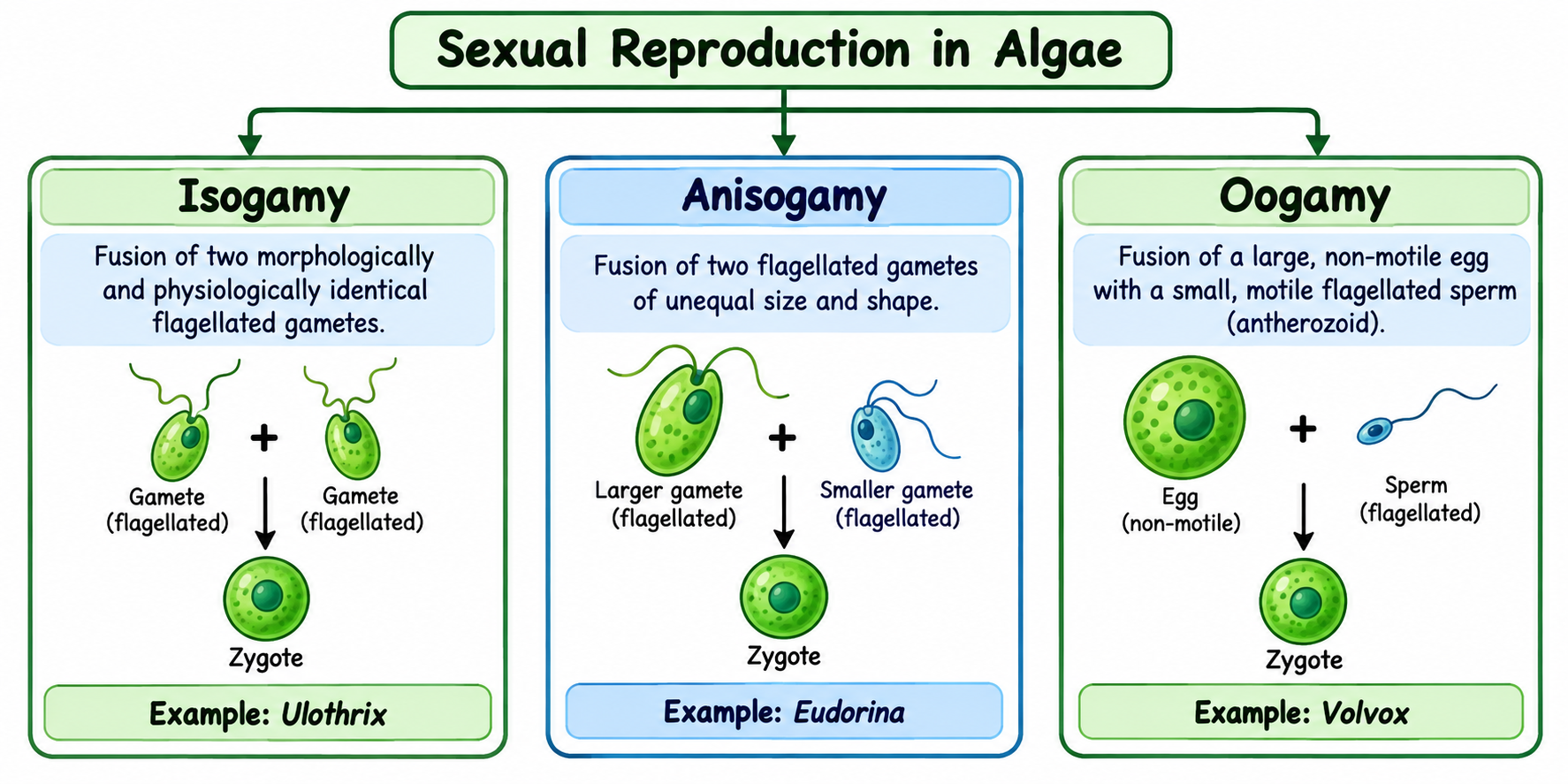
Fig. 3.6 — Flowchart of sexual reproduction in algae: Isogamy (Ulothrix), Anisogamy (Eudorina), and Oogamy (Volvox)
NEET 2022
Agar-agar is obtained from which of the following?
Answer: Gelidium and Gracilaria (Red Algae / Rhodophyceae)
NEET 2019
Floridean starch is the reserve food of which algae?
Answer: Rhodophyceae (Red Algae)
NEET 2020
Which of the following algae has cell wall made of silica?
Answer: Diatoms (Bacillariophyceae) — their siliceous walls are called frustules
NEET 2017
Fucoxanthin is the characteristic pigment of:
Answer: Phaeophyceae (Brown Algae)
Bryophytes are called the "Amphibians of the Plant Kingdom" because they can live on land but require water for sexual reproduction. They are the first true land plants, representing a major evolutionary step from aquatic algae to terrestrial vascular plants.
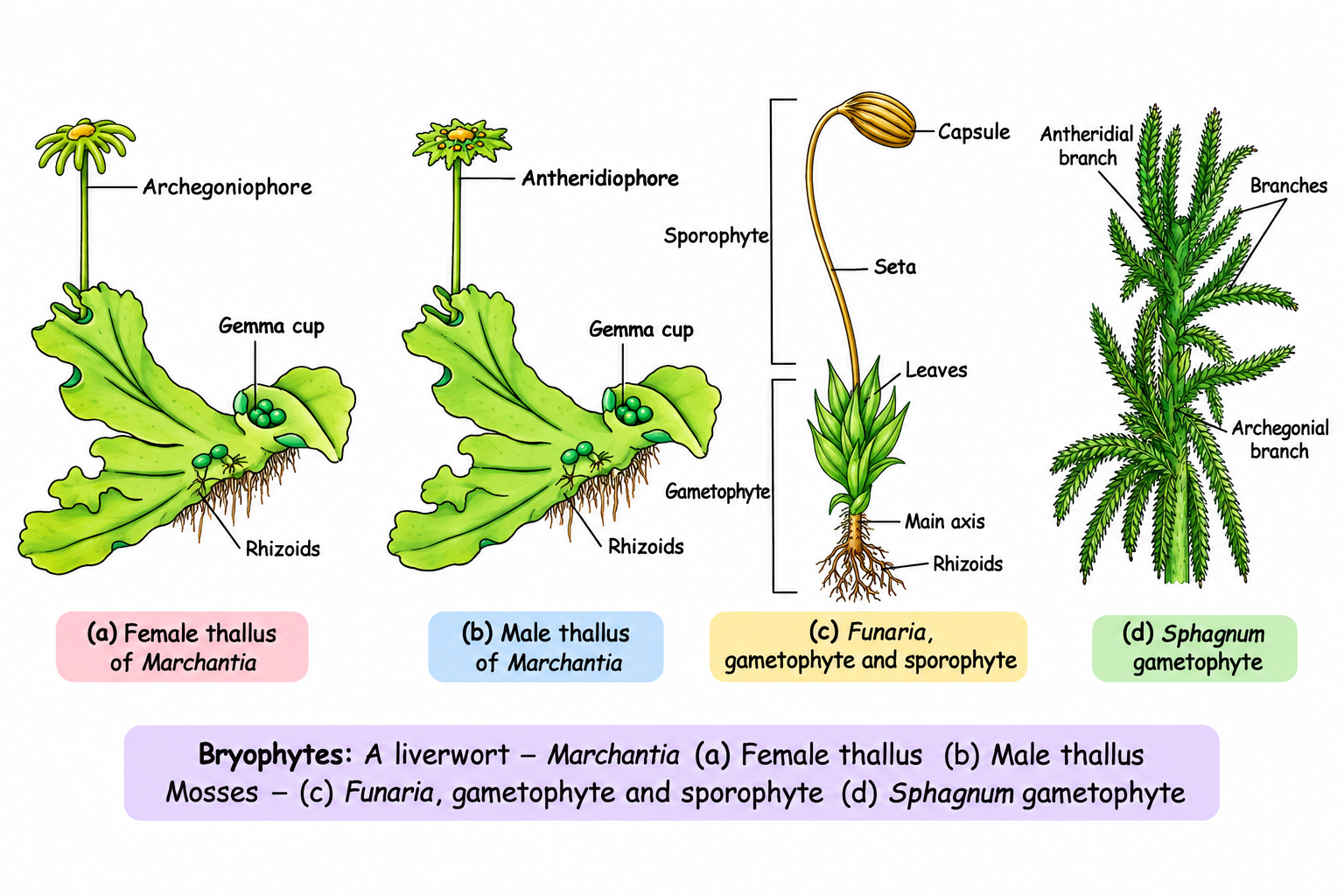
Fig. 3.2 — Bryophyte life cycles: Marchantia (liverwort) and Funaria (moss) showing gametophyte and sporophyte stages
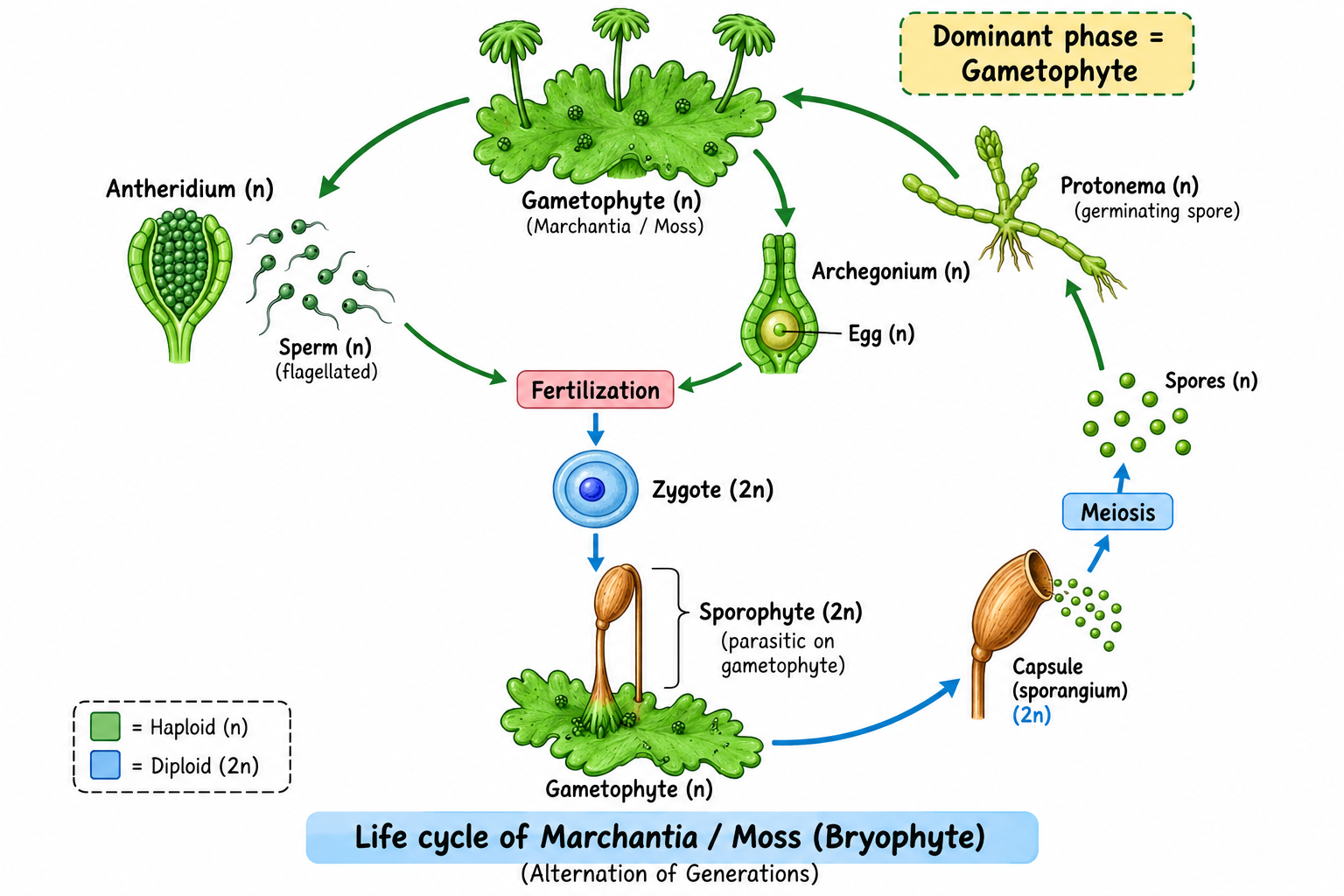
Fig. 3.7 — Life cycle of Bryophyte (Marchantia/Moss): alternation of generations showing dominant haploid gametophyte and dependent diploid sporophyte
NEET 2023
Which among the following is called "Amphibians of Plant Kingdom"?
Answer: Bryophytes
NEET 2021
In mosses the sporophyte is:
Answer: Partially dependent on gametophyte (attached to it, derives nutrition through haustoria)
NEET 2018
Gemma cups are found in:
Answer: Marchantia (liverworts)
NEET 2016
In bryophytes, the dominant phase of the life cycle is:
Answer: Gametophyte (n)
Pteridophytes are the first true vascular land plants. They have true roots, stems, and leaves with a well-developed vascular system (xylem and phloem). They are also called "Vascular Cryptogams" (no seeds) or "Botanical Snakes". The study of pteridophytes is called Pteridology.
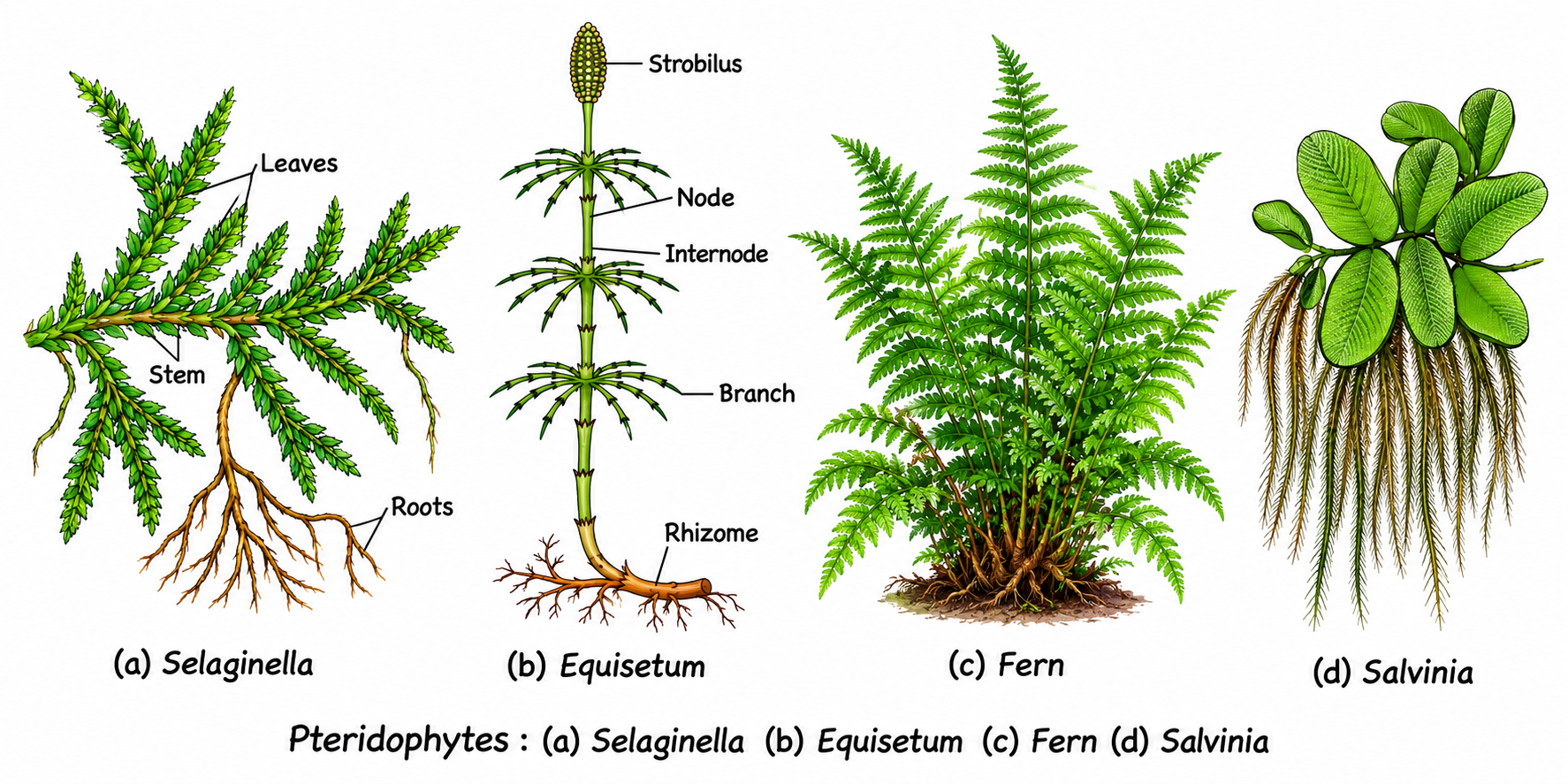
Fig. 3.3 — Pteridophyte diversity: Selaginella, Equisetum (strobili), Pteris (sori on leaves), and Lycopodium
| Class | Common Name | Leaves | Spore type | Examples |
|---|---|---|---|---|
| Psilopsida | Whisk ferns | No true leaves (scale-like) | Homosporous | Psilotum |
| Lycopsida | Club mosses / Spike mosses | Microphylls | Homosporous / Heterosporous | Selaginella, Lycopodium |
| Sphenopsida | Horsetails | Microphylls in whorls | Homosporous | Equisetum |
| Pteropsida | True Ferns | Megaphylls (large fronds) | Mostly Homosporous | Dryopteris, Pteris, Adiantum, Azolla, Marsilea |
Heterospory = production of two morphologically distinct types of spores
Examples of heterosporous pteridophytes: Selaginella, Salvinia, Azolla, Marsilea, Isoetes
Significance: In some pteridophytes, the megaspore germinates while still retained inside the megasporangium — this is the precursor to seed habit. This is the crucial evolutionary link to Gymnosperms.
The central vascular cylinder in pteridophyte stems is called the stele. Types include:
NEET 2022
Heterospory is significant as it is related to:
Answer: Evolution of seed habit
NEET 2021
Which pteridophyte is used as biofertilizer?
Answer: Azolla (harbours N₂-fixing Anabaena azollae)
NEET 2020
In pteridophytes, the first land plant to have vascular tissue is:
Answer: Pteridophytes are the FIRST vascular cryptogams
NEET 2019
Which of the following is heterosporous?
Answer: Selaginella and Salvinia
The word Gymnosperm comes from Greek: gymnos = naked + sperma = seed. Hence gymnosperms are plants with naked seeds (seeds not enclosed in fruits — no ovary/fruit wall). They are the first seed-bearing plants (spermatophytes).
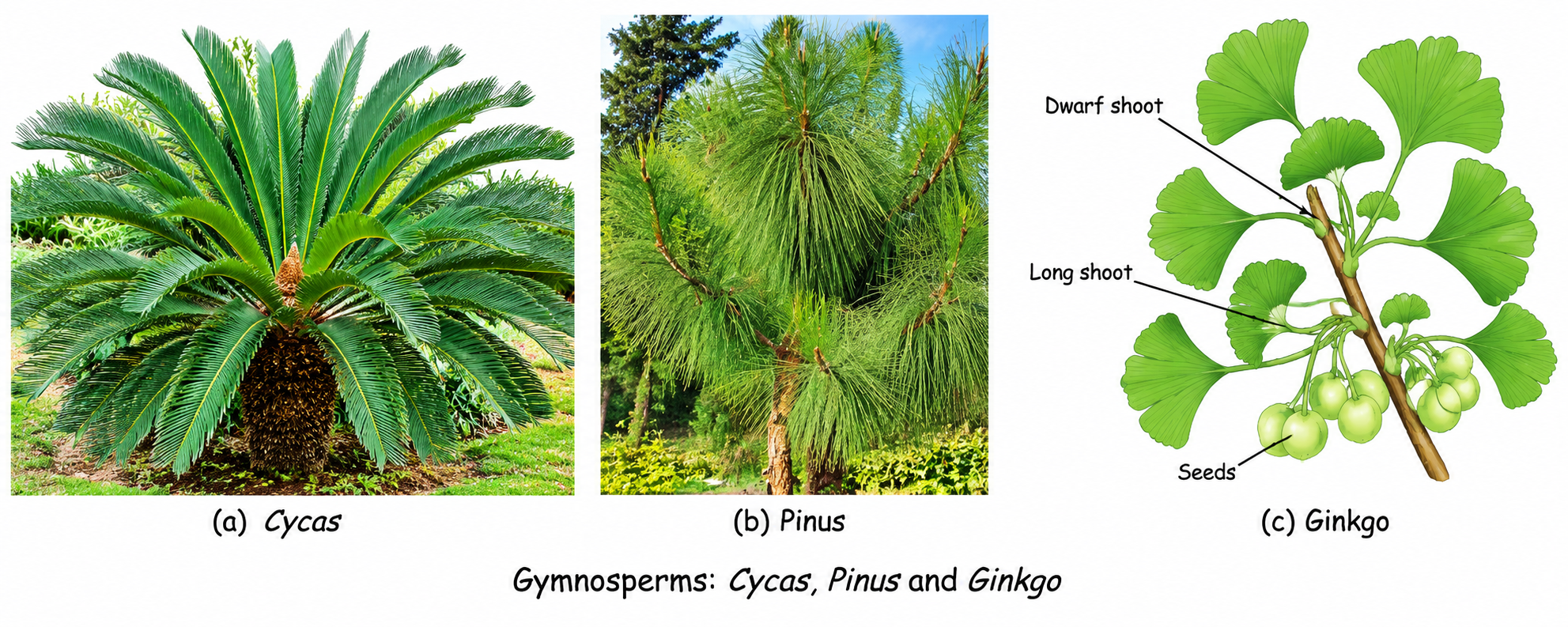
Fig. 3.4 — Gymnosperms: Cycas (coralloid roots & pinnate leaves), Pinus (male & female cones), and Ginkgo
| Order/Division | Common Name | Special Features | Examples |
|---|---|---|---|
| Cycadales | Cycads | Palm-like; coralloid roots; motile multiflagellate sperms; largest ovules in plant kingdom (Cycas) | Cycas, Zamia |
| Coniferales | Conifers | Cone-bearing; needle leaves; resin canals; most abundant gymnosperms | Pinus, Cedrus, Abies, Picea, Juniperus, Larix |
| Gnetales | Gnetophytes | Most angiosperm-like; vessels in xylem; dicot-like leaves | Gnetum, Ephedra, Welwitschia |
| Ginkgoales | Maidenhair Tree | "Living fossil"; fan-shaped leaves; motile sperms | Ginkgo biloba |
NEET 2023
Coralloid roots are found in:
Answer: Cycas — they harbour symbiotic nitrogen-fixing Anabaena/Nostoc
NEET 2022
Which gymnosperm has vessels in xylem (angiosperm-like)?
Answer: Gnetum
NEET 2021
Ephedrine drug is obtained from:
Answer: Ephedra (Gymnosperm)
NEET 2020
Double fertilisation is absent in:
Answer: Gymnosperms
NEET 2019
Male gametophyte with least number of cells is found in:
Answer: Angiosperms — 3-celled (tube cell + 2 male gametes)
Angiosperms are the most evolved, dominant, and most diverse group of plants on Earth. The word means "enclosed seed" (Greek: angio = vessel/container + sperma = seed). The key feature is that ovules are enclosed within an ovary, which matures into a fruit after fertilisation. They are also called Flowering Plants.
| Character | Monocotyledonae (Monocots) | Dicotyledonae (Dicots) |
|---|---|---|
| Cotyledons (seed leaves) | ONE cotyledon (Scutellum) | TWO cotyledons |
| Leaf venation | Parallel venation | Reticulate (network) venation |
| Root system | Fibrous (adventitious) roots | Tap root system |
| Flower | Trimerous (parts in 3s or multiples of 3) | Tetramerous/Pentamerous (4s or 5s) |
| Stem vascular bundles | Scattered (atactostele); closed (no cambium) | Ring arrangement (eustele); open (with cambium) |
| Secondary growth | Absent (generally) | Present (due to cambium) |
| Pollen apertures | Monosulcate (1 pore/aperture) | Tricolpate (3 apertures) |
| Examples | Wheat, Rice, Maize, Sugarcane, Grass, Onion, Banana, Coconut | Mango, Pea, Rose, Sunflower, Bean, Mustard, Neem, Tomato |
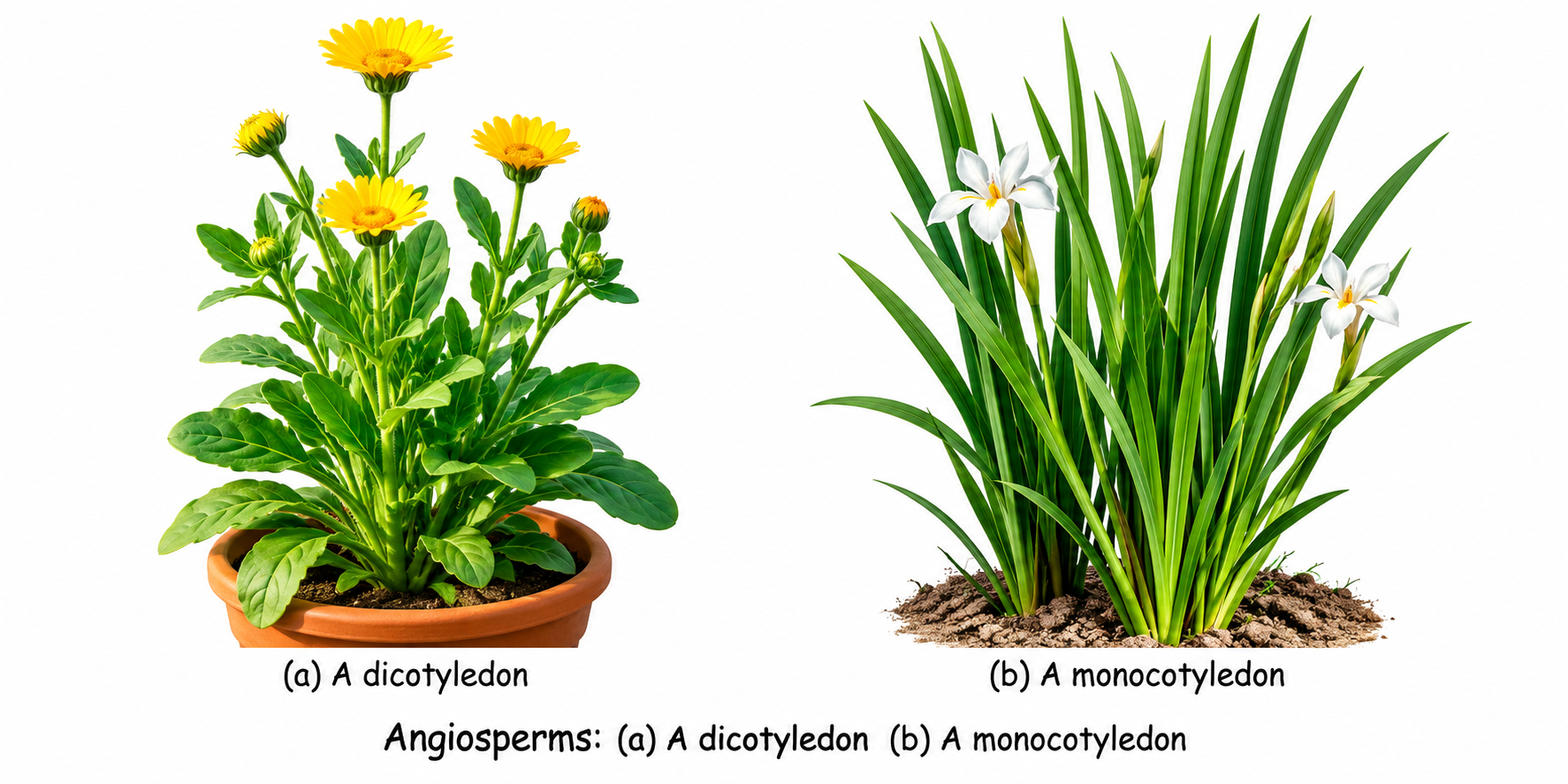
Fig. 3.5 — Angiosperms: comparing monocot and dicot structures — roots, stems, leaves, flowers, and seeds
"Mono = ONE, Di = TWO" — count the seed leaves (cotyledons)
Monocot leaves look like roads (parallel lines), Dicot leaves look like a net (reticulate)
Mono-Fibrous root (both start with F-like sounds) vs Dicot-Tap root (Dicots go Deep)
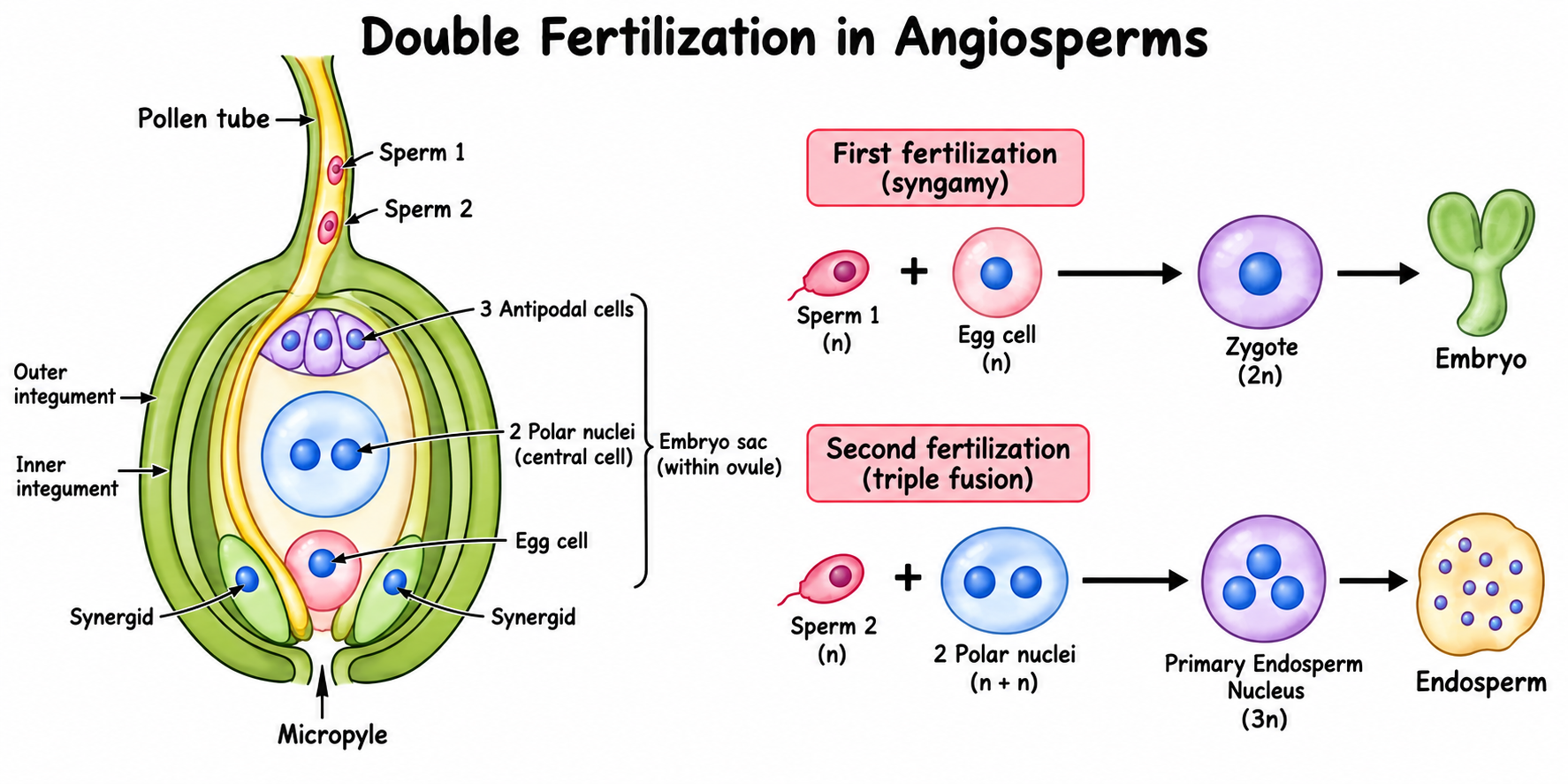
Fig. 3.8 — Double fertilisation in angiosperms: Sperm 1 + Egg (n) → Zygote (2n); Sperm 2 + 2 Polar nuclei (n+n) → Primary Endosperm Nucleus (3n)
NEET 2023
Double fertilization is a characteristic feature of:
Answer: Angiosperms only
NEET 2022
The endosperm in angiosperms is:
Answer: Triploid (3n) — formed by triple fusion (sperm + 2 polar nuclei)
NEET 2021
Smallest angiosperm / smallest flowering plant:
Answer: Wolffia
NEET 2020
In angiosperms, the pollen grain represents:
Answer: Male gametophyte (microgametophyte)
All plants show alternation of generations — a regular alternation between a haploid gametophyte phase (n) and a diploid sporophyte phase (2n). The relative dominance of each phase varies across plant groups.
| Life Cycle Type | Dominant Phase | Found In |
|---|---|---|
| Haplontic | Gametophyte (n); Sporophyte reduced to zygote only | Most algae (Volvox, Spirogyra, Chlamydomonas) |
| Diplontic | Sporophyte (2n); Gametophyte reduced to few cells | Most Phaeophyceae (Fucus), All Gymnosperms, All Angiosperms |
| Haplo-diplontic (Intermediate) |
Both phases multicellular and free-living (though one may be larger) | Bryophytes (gametophyte dominant), Pteridophytes (sporophyte dominant); Some algae (Ectocarpus, Ulva) |
| Feature | Algae | Bryophyta | Pteridophyta | Gymnospermae | Angiospermae |
|---|---|---|---|---|---|
| Plant body | Thallus | Thallus/Leafy gametophyte | True root, stem, leaf (sporophyte) | True root, stem, leaf | True root, stem, leaf |
| Vascular tissue | Absent | Absent | Present (no vessels) | Present (mostly no vessels) | Present (with vessels) |
| Seeds | Absent | Absent | Absent | Present (Naked) | Present (Enclosed) |
| Flowers/Fruits | Absent | Absent | Absent | Absent | Present |
| Dominant phase | Gametophyte (n) | Gametophyte (n) | Sporophyte (2n) | Sporophyte (2n) | Sporophyte (2n) |
| Fertilisation needs water? | Yes | Yes | Yes | No (pollen tube) | No (pollen tube) |
| Double fertilisation | Absent | Absent | Absent | Absent | Present |
| Endosperm | Absent | Absent | Absent | Present (haploid, before fertilization) | Present (triploid 3n, after fertilization) |
| Examples | Spirogyra, Sargassum, Porphyra | Marchantia, Funaria | Selaginella, Pteris, Equisetum | Pinus, Cycas, Gnetum | All flowering plants |
Q1. What is the common name of Phaeophyceae?
Answer: Brown Algae. The brown colour is due to the pigment Fucoxanthin.
Q2. Why are bryophytes called "Amphibians of the Plant Kingdom"?
Answer: Bryophytes are called amphibians of the plant kingdom because:
This dual existence — land living but water-dependent for reproduction — mirrors the amphibians among animals.
Q3. Differentiate between liverworts and mosses.
| Character | Liverworts | Mosses |
|---|---|---|
| Body shape | Flat, ribbon-like, dorsiventral thallus | More differentiated, stem + leaf-like |
| Rhizoids | Unicellular (smooth or tuberculate) | Multicellular, branched |
| Protonema | Absent or rudimentary | Prominent (filamentous stage) |
| Gemma cups | Present (Marchantia) | Absent |
| Sporophyte | Foot + Seta + Capsule (simple) | Foot + Seta + Capsule (with columella & peristome) |
| Examples | Marchantia, Riccia | Funaria, Sphagnum, Polytrichum |
Q4. What is heterospory? Why is it significant? Give two examples of heterosporous pteridophytes.
Heterospory: The production of two morphologically distinct types of spores — smaller microspores (giving rise to male gametophyte) and larger megaspores (giving rise to female gametophyte).
Significance:
Examples: Selaginella and Salvinia
Q5. Write the salient features of Gymnosperms. Give two examples each of: (a) Coniferales, (b) Cycadales.
Salient features of Gymnosperms:
(a) Coniferales: Pinus (Chir Pine), Cedrus (Deodar)
(b) Cycadales: Cycas (Sago Palm), Zamia
Algae Facts
• Chlorella and Spirulina — used as food/protein supplement in space research
• Dunaliella — produces β-carotene (anti-oxidant, Vitamin A precursor)
• Diatoms — chief producers of O₂; their diatomite used in dynamite (Nobel's discovery)
• Laminaria — source of iodine and algin
• Sargassum — forms Sargasso Sea (Atlantic Ocean); pelagic (floating) brown alga
Bryophyte Facts
• In mosses, the protonema is the juvenile stage that resembles filamentous algae
• Sporophyte of bryophytes obtains nutrition from gametophyte through a foot (haustorial absorption)
• In Riccia — simplest sporophyte (only capsule, no seta)
• In Funaria — sporophyte has all 3 parts: foot + seta + capsule
• Peristome teeth in moss capsule show hygroscopic movement for spore dispersal
Pteridophyte Facts
• Fern gametophyte = Prothallus — heart-shaped, 1-cell thick, independent, photosynthetic
• Sori in ferns = clusters of sporangia on undersurface of leaves (fronds)
• Indusium = protective covering over sorus
• Equisetum has jointed stem and whorled microphylls — stem has silica deposits
• Psilotum — most primitive vascular plant; no true roots/leaves (only rhizoids)
Gymnosperm Facts
• Cycas — the only gymnosperm without true female cone (loose megasporophylls)
• Welwitschia — produces only 2 leaves throughout its life (500-1000 years); desert plant
• Ginkgo biloba — "Living fossil"; fan-shaped (bilobed) leaves; dioecious; used for memory enhancement
• Sequoia giganteum (Giant Sequoia) — tallest known gymnosperm
• Pollen grains of Pinus are winged (bisaccate) — 2 air bladders for buoyancy in wind
Angiosperm Facts
• Wolffia — smallest angiosperm (1-2 mm); aquatic
• Eucalyptus — tallest angiosperm (100 m)
• Embryo sac = 7-celled, 8-nucleate (3 antipodal + 2 polar nuclei + 1 egg + 2 synergids)
• Largest seed: Lodoicea maldivica (Double coconut / Coco de Mer)
• Largest inflorescence: Amorphophallus titanum; Largest flower: Rafflesia (parasitic)
• Trapa (Water chestnut) — submerged plant but flowers above water
Plant Kingdom Evolution: "All Big Plants Generally Advance"
→ Algae → Bryophytes → Pteridophytes → Gymnosperms → Angiosperms
For Algae Classes (3 colours): "Green algae have Green Chl-a+b | Brown algae have Brown Fucoxanthin | Red algae have Red Phycoerythrin"
Bryophytes features: NAWL
→ No vascular tissue | Amphibians of plant kingdom | Water needed for fertilisation | Land plants (first true)
Gymnosperms — 4 features: NHAW
→ Naked seeds | Heterosporous | Anemophilous (wind pollinated) | Woody (all trees/shrubs)
Angiosperms ONLY feature: "Angiosperms DOUBLE everything" — Double fertilisation, Double endosperm origin (3n)
Q. Which of the following is NOT a characteristic of gymnosperms?
(a) Naked seeds (b) Double fertilization (c) Wind pollination (d) Heterospory
Answer: (b) Double fertilization — Double fertilization is exclusively found in Angiosperms. Gymnosperms have single fertilization.
Q. Match the algae with its economic importance:
A. Gelidium — (i) Algin
B. Sargassum — (ii) Agar-agar
C. Porphyra — (iii) Carrageenan
D. Chondrus — (iv) Food (eaten in East Asia)
Answer:
Q. Identify the CORRECT match for the ploidy of different stages in the life cycle of a plant:
(a) Endosperm of Angiosperm — 3n
(b) Endosperm of Gymnosperm — 3n
(c) Prothallus of Pteridophyte — 2n
(d) Spores of Bryophyte — 2n
Answer: (a) Endosperm of Angiosperm = 3n ✓